The Pepsi Challenge: Blind Taste Test
This Pepsi commercial leverages the 'Pepsi Challenge' blind taste test to assert superior taste over Coca-Cola. It depicts a series of consumers participating in the challenge, highlighting the objective results through on-screen text and a confident voiceover to persuade viewers to choose Pepsi.
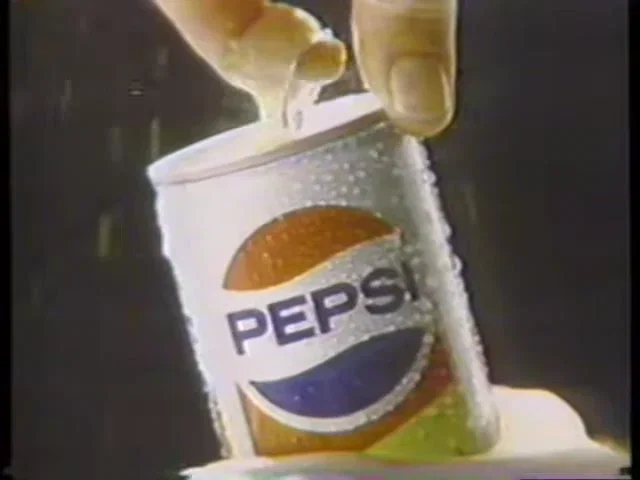
At the 0:05 mark, a hand with a thumb ring is seen pouring a cold, condensation-covered Pepsi can, distinguished by its red, white, and blue logo, with liquid spilling over the top and down the sides of the can. The camera is framed in a tight close-up, focusing on the action of pouring and the visual appeal of the chilled beverage.
This moment establishes the product (Pepsi) and the core 'challenge' concept visually by showing the preparation of the beverage, implying a refreshing experience that will be put to the test.
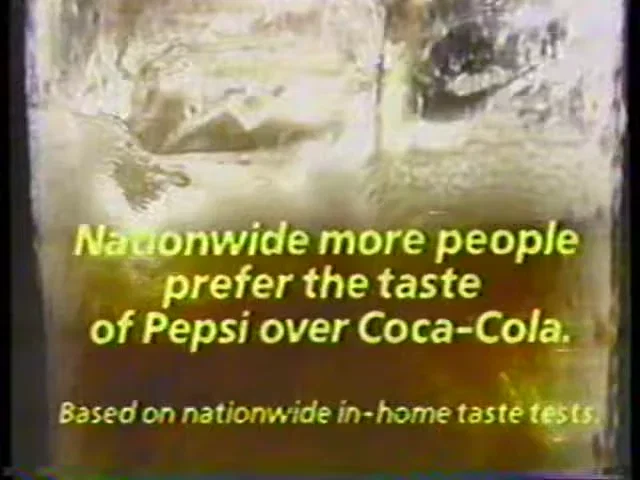
At 0:16, the frame shows a close-up of a carbonated cola beverage inside a glass, with bubbles actively rising. Overlaid in bright green text are the lines: 'Nationwide more people prefer the taste of Pepsi over Coca-Cola.' and 'Based on nationwide in-home taste tests.' The camera remains static, emphasizing the on-screen claim.
This moment directly presents the central evidence and outcome of the 'Pepsi Challenge' treatment, providing a clear, quantitative claim derived from the blind taste tests, visually reinforcing the voiceover's message.
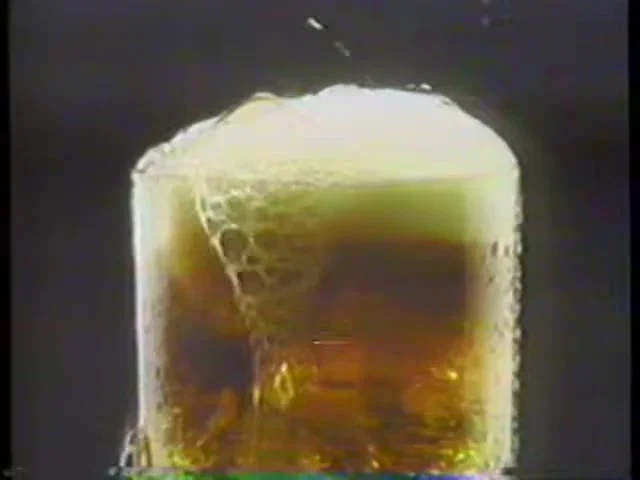
At 0:25, a clear glass filled with a dark carbonated beverage is shown. The drink is actively fizzing, creating a significant head of foam that overflows the top of the glass. Droplets of liquid are visible around the rim and falling from the foam. The background is a soft, dark blur, keeping the focus entirely on the effervescent drink. No on-screen text or branding is visible at this exact moment.
This moment visually connects the promise of superior taste (as proven by the challenge) to the refreshing, desirable product itself, acting as a final visual payoff that reinforces the enjoyment and quality of Pepsi as 'the real thing'.
Selected frames, transcript, motion, and sound. Source & coverage below.
An approach to borrow.
A creative director or strategist should reference this film structure when aiming to directly compare a product against a competitor based on a single, clear metric (like taste), utilizing a demonstration-heavy approach with strong, factual claims and a direct call to action. It's particularly useful for campaigns focused on challenging established market leaders or for products where a direct comparison is a key selling point.
The inquiry moments seamlessly connect: the opening subject introduces Pepsi and the challenge, the treatment directly presents the results of the taste test through text and visuals, and the final connection visually celebrates the product, tying the proven preference back to the refreshing experience of Pepsi. This creates a cohesive narrative from problem to proof to payoff.
Study notes & sources
How the film develops
Opening
The opening visually establishes Pepsi as a refreshing cola and introduces the idea of a taste challenge against Coca-Cola through the voiceover.
Development
The mid-film visually depicts diverse individuals participating in the blind taste test and then reinforces the results with bold on-screen textual claims of Pepsi's widespread preference.
Payoff
The closing resolution delivers a final, highly appealing visual of an effervescent, overflowing glass of Pepsi, culminating in a direct call to action for the viewer to 'let your taste decide'.
Speech, sound & motion notes
The audio track consists solely of a confident male voiceover, delivering a narrative that guides the viewer through the premise, execution, and results of the Pepsi Challenge. There is no music or distinct sound effects, and silence dynamics are minimal, indicating continuous narration.
Interpretation limits
This Pepsi commercial leverages the 'Pepsi Challenge' blind taste test to assert superior taste over Coca-Cola. It depicts a series of consumers participating in the challenge, highlighting the objective results through on-screen text and a confident voiceover to persuade viewers to choose Pepsi. Algorithmic 10fps motion telemetry and 16-bit PCM acoustic metrics measure cut frequency, optical movement, and loudness dynamics, but do not replace human continuous-playback viewing or independent sound-mix listening, nor do they establish commercial ROI or audience conversion outcomes.
Bring your own brief.
Discuss the choices that could serve your project.